
Azadeh Gholizadeh
 Azadeh Gholizadeh (b. 1982, Tehran, Iran) earned an MFA from the School of the Art Institute of Chicago and an MA in Architecture and Urbanism from Iran University of Science & Technology in Tehran. Drawing on her experiences of connection and belonging, she makes tapestries and sculptures that explore the emotional significance of landscape, hand-woven tapestries. Gholizadeh’s latest works examine the interplay between pictorial perspective and personal meaning, inviting viewers to contemplate how our surroundings shape our emotional lives.
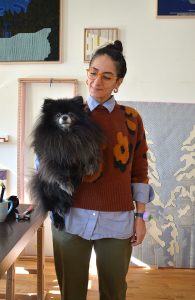
Gholizadeh has been awarded residencies at the Arctic Circle Residency, Yaddo, Chicago Artist Coalition, and ACRE. In 2022, Gholizadeh was a Chicago Artadia Awardee and Hopper Prize Spring Chapter winner. Gholizadeh’s solo exhibitions include Dawn to Dusk at Goldfinch Gallery, Oh, Swallow, Where Do You Live in Winter? at Apparatus Projects and Within the Threshold at Chicago Artist Coalition. Azadeh Gholizadeh lives and works in Seattle, Washington. Gholizadeh’s solo booth, part of Curated Spotlight at NADA Miami, was featured in the New York Times’s “More Miami Art Fairs to Explore.”
Gholizadeh explores the relationship between landscape and memory, contemplating how absence, distance, desire, and longing intertwine to shape our experiences. She is interested in how emotional discomfort and distress can become a form of endurance and transform Pain into a conversation between past and present. She uses traditional women-centric fiber art techniques to make needlepoint tapestries and sculptural installations that evoke a sense of nostalgia. Her artwork explores and draws upon ideas about light, time, color, and memory. Gholizadeh also delves into modernist grids, digital vs. analog perspectives, pixelation, and Persian manuscripts such as the Shah Nama and Persian gardens.
She photographs landscapes and digitally translates them into geometric shapes, stripping away extraneous details to distill the essence of memory and emotion. She then uses yarn, felt, and painted canvas mesh to create tapestries with a framework of horizontal and vertical lines so the final imagery appears pixelated. Through this process, Gholizadeh reflects on the idea of home, which is fragile, inconsistent, and perspectival. She is less interested in accurately depicting nature and more focused on how it can be transformed through color, materials, and composition.


- info@rulegallery.com 303-800-6776
- © 2026 RULE Gallery. All rights reserved.